You want a clean home or workspace, but you don't want the sharp smell, sticky residue, or nagging doubt about what's been sprayed on your surfaces. That's usually the point where people start looking at green cleaning companies.
Good. You should.
Hiring a cleaner isn't only about getting rid of dust and grime. It's about deciding what kind of products, equipment, and working methods you're comfortable bringing into your home, office, rental property, or holiday let. The problem is that plenty of companies say they're “eco-friendly” without giving you anything solid to check.
That's where many consumers encounter a challenge. They seek a greener option, but are unsure how to discern between a careful operator and clever marketing.
Why More People Are Choosing Green Cleaning
A lot of people start with the same simple goal. They want a place that feels fresh, not chemically overwhelmed. They want surfaces cleaned properly without a heavy synthetic scent hanging in the air afterwards. If there are children, pets, guests, tenants, or staff involved, that concern gets even stronger.
That shift isn't niche anymore. The UK cleaning services market is expanding as professional cleaning becomes a routine purchase for households and businesses, and buyers increasingly ask for lower-toxicity, eco-friendly methods, especially in offices, lettings, and homes, according to Grand View Research's cleaning services market report.
Why this matters at home
For homeowners and tenants, green cleaning usually starts as a health and comfort decision. You want fewer harsh odours, less residue on kitchen and bathroom surfaces, and a cleaning routine that doesn't make your home feel like a treatment room.
That doesn't mean accepting lower standards. Good green cleaning companies should still leave bathrooms sanitised, kitchens degreased, floors spotless, and high-touch areas properly cleaned. The difference is in how they get there.
Why businesses are making the switch
Small businesses, landlords, and letting agents have a second reason. They need spaces that are clean, presentable, and easier for people to occupy straight away. Lower-odour products and sensible equipment choices make that easier in offices, end-of-tenancy settings, and short-let turnarounds.
Practical rule: If a company talks only about being “kind to the planet” but says nothing about occupant comfort, indoor air quality, or safer product choices, their green pitch is incomplete.
If you manage a workplace or larger premises, this green cleaning guide for facility managers gives useful context on what professional buyers often look for. If you're focused on your own property first, these eco-friendly cleaning tips for a greener home are a practical starting point before you hire anyone.
What Makes a Cleaning Company Truly Green
Most green claims are too vague to be useful. “Natural.” “Eco.” “Non-toxic.” Those words sound reassuring, but on their own they don't prove much. A company is only worth trusting if it can explain its products, methods, and waste choices clearly.
The strongest UK-facing benchmark is the EU Ecolabel framework used in the UK, which dates back to 1992 and helps identify lower-impact detergents and cleaners, making it easier for customers to verify criteria such as low toxicity, biodegradability, and reduced packaging waste, as outlined by the EPA's overview of greener cleaning product identification.
Products should meet a real standard
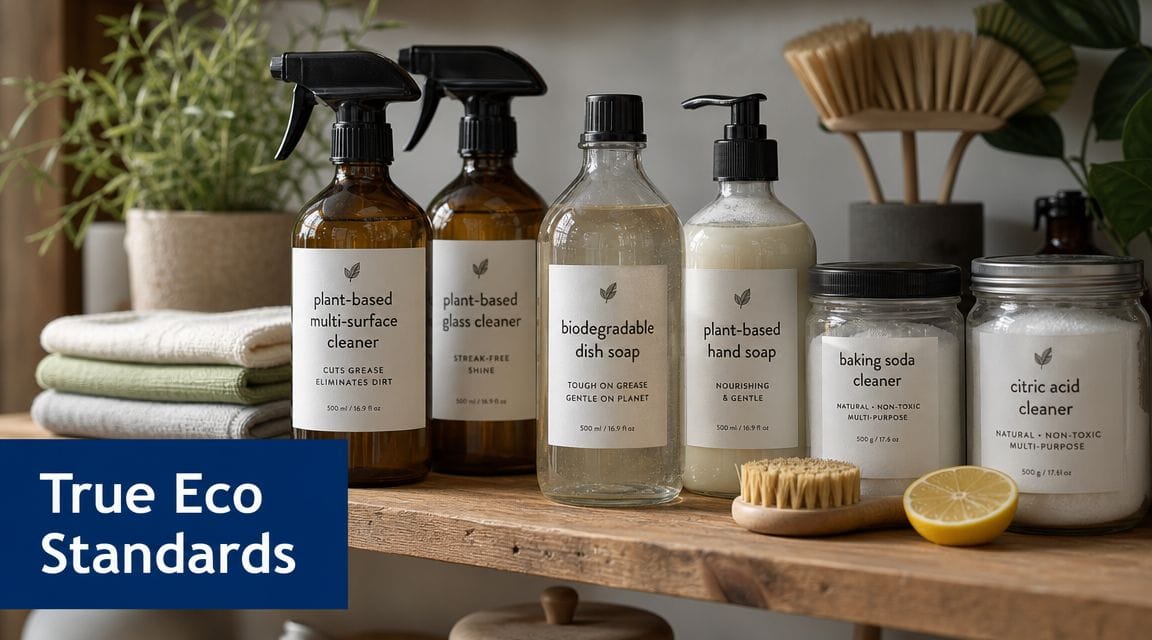
The first thing to check is product selection. Strong green cleaning companies don't rely on vague buzzwords. They choose products that line up with recognised criteria around lower toxicity, biodegradable ingredients, lower VOC content, and less wasteful packaging.
You don't need to become a chemist. You do need to ask direct questions.
Look for cleaners who can tell you:
- Which products they use and why they chose them
- Whether those products have recognised environmental credentials
- Whether they can provide COSHH information when relevant
- Whether they use concentrates or refill systems instead of constant single-use bottles
If you want a simple consumer-level example of how green product choices are discussed, this eco friendly all-purpose cleaner guide is useful for understanding what to look for in everyday cleaning products.
Practice matters as much as product
A cleaner can use a decent spray and still work badly. That's why you need to look beyond labels.
A true green approach usually includes systems that reduce overuse, prevent contamination, and improve consistency. Colour-coded cloths are a good example. They help stop the same tools being carried from one area to another without control. Microfibre systems, careful dosing, and sensible route planning also matter because they reduce waste and rework.
Green cleaning is a process, not a perfume choice.
Packaging and waste are part of the claim
This is the bit many companies skip. If a business talks endlessly about “natural ingredients” but turns up with stacks of disposable plastic bottles, that should make you pause.
The better green cleaning companies think about packaging as part of the service. They favour concentrates, refillable containers, and waste-aware product handling. That's a better sign of discipline than any leafy logo on a website banner.
Green Cleaning Services for Every Need
Some people still assume green cleaning is only suitable for light domestic tidying. It isn't. A competent provider should be able to apply greener methods across a wide range of cleaning jobs without sacrificing standards.
For households, the obvious starting point is regular domestic cleaning. That covers kitchens, bathrooms, dusting, vacuuming, mopping, and general upkeep. If you want your home cleaned regularly without a strong chemical smell left behind, green cleaning companies provide the most immediate difference.
Domestic and specialist jobs
There's also no reason to limit green cleaning to weekly visits. Plenty of clients want a one-off deep clean before guests arrive, after renovations, or when a property has been neglected for a while. In those cases, the company should explain which products and tools they use for heavier soil, limescale, grease, and built-up dust.
Specialist domestic services can also be handled with a greener approach, including:
- End-of-tenancy cleaning for rented properties that need to be reset properly
- Move-in and move-out cleaning when you want a clean start without harsh residue
- Oven cleaning where product strength matters, but safe handling matters too
- Carpet cleaning where method, drying time, and product choice all affect the result
- Window cleaning for homes and smaller premises
- Outdoor cleaning and roof cleaning where the operator should explain surface-safe methods clearly
Commercial and short-let cleaning
For businesses, green cleaning companies often support commercial cleaning for offices and shared premises. That includes workstations, washrooms, kitchens, floors, and touchpoints in spaces where staff and visitors need a clean environment without overpowering odours.
Landlords, property managers, and hosts also have strong reasons to choose greener methods. Airbnb and holiday let turnarounds need to be efficient, presentable, and ready for the next guest. A sensible low-residue approach helps properties feel clean without that heavy “just sprayed” smell.
Here's the practical takeaway. You don't need to choose between a broad service range and greener standards. You need a company that can explain how it adapts its methods to the specific job.
Your Checklist for Hiring a Green Cleaner
If you remember one thing, remember this. Don't hire based on the word “eco”. Hire based on proof.
The best green cleaning companies can answer straightforward questions without getting defensive or vague. If they dodge, waffle, or shift back into marketing language, move on.
Ask about equipment, not just liquids
Products get all the attention, but equipment tells you a lot about how seriously a company works. Professional standards often specify vacuum cleaners that capture 96% of particulates at 0.3 microns and operate below 70 dB, according to the green cleaning policy document from Cal State Fullerton. That matters because filtration affects indoor air quality, and lower-noise equipment is better in occupied homes and workplaces.
Ask whether they use:
- High-filtration vacuums for dust control
- Colour-coded cloths and mop systems to reduce cross-contamination
- Metered or dose-controlled systems so products aren't overused
- Electric or battery-powered equipment where suitable
If a cleaner can explain their kit clearly, that's usually a better sign than a polished slogan on social media.
Use this hiring checklist
You don't need a long interview. You need the right questions.
| Green Cleaner Hiring Checklist | |
|---|---|
| Area to Check | What to Ask or Look For |
| Products | Ask for the names of the products they use and whether they can explain why those products fit a green approach. |
| Certifications | Look for recognised product certifications or clear evidence that products meet lower-impact criteria. |
| COSHH information | Ask whether they can provide COSHH details where relevant, especially for commercial or end-of-tenancy work. |
| Equipment | Ask what vacuum, floor, and application equipment they use, and whether they use high-filtration, low-noise tools. |
| Cross-contamination control | Check whether they use colour-coded cloths, mop heads, or room-specific systems. |
| Waste reduction | Ask whether they use concentrates, refill bottles, or reusable systems instead of repeated single-use packaging. |
| Staff training | Ask how staff are trained on product use, dilution, and safe cleaning routines. |
| Insurance | Verify that the cleaner or company is insured before work starts. |
| Reviews | Read customer feedback for specifics, not just star ratings. Look for comments on reliability, communication, and care. |
| Written clarity | Check whether their profile or quote clearly states what’s included, rather than hiding behind general “eco” wording. |
What a good answer sounds like
A good provider sounds calm and specific. They'll name products, explain systems, and answer without fuss. They won't act like basic questions are a challenge to their credibility.
A weak provider usually leans on adjectives. “Safe.” “Natural.” “Green.” “Premium.” None of that means much unless they can back it up.
Costs Red Flags and Spotting Greenwashing
Let's deal with the cost question properly. Some people assume green cleaning companies always charge more. Sometimes they do. Sometimes they don't. The smarter question is whether the company works efficiently and explains what you're paying for.
A cleaner using concentrates, refill systems, reusable materials, and well-managed dosing may control waste better than a company burning through throwaway bottles and overusing product on every visit. That's why price alone is a poor filter. Look at method, not just the quote.
The lifecycle question most buyers forget
One of the most overlooked issues is lifecycle impact. Government guidance discussed in relation to WRAP prioritises re-use and refill models to cut packaging waste, which means a genuinely green service should be able to discuss not only whether a product is low-toxicity, but also whether its service model reduces waste and transport impact, as noted in this discussion of sustainable green cleaning and refill-focused service models.
That's worth pressing on. Ready-to-use sprays in endless plastic bottles might sound convenient, but they're not automatically the best choice. A cleaner using concentrated products and refillable systems may have a far stronger environmental case.
If you're comparing overall value as well as service type, this guide on how much a house cleaner costs gives useful context before you start messaging providers.
Red flags you should take seriously
Some warning signs are obvious once you know what to look for.
- Vague magic words. If the website says “chemical-free”, be sceptical. Cleaning products are still chemical formulations. Serious firms don't rely on impossible claims.
- No product transparency. If they won't name products or explain systems, that's a problem.
- No paperwork or safety information. Commercial clients and careful homeowners should expect clearer answers than “don't worry, it's all natural”.
- Too much focus on branding. Leaf imagery and recycled paper graphics don't prove anything.
- No mention of refills, concentrates, or reusable systems. A company can't claim a broad green approach while ignoring packaging and waste.
Good green cleaning companies make verification easy. Weak ones make you work for basic facts.
Find and Verify Green Cleaners on Cleaner Connect
The hardest part of hiring isn't deciding that you want a greener cleaner. It's checking whether the company lives up to the claim.
That matters even more because the UK's Competition and Markets Authority has a Green Claims Code requiring environmental claims to be truthful and substantiated. In practice, that means you should look for evidence such as product certifications and COSHH information, not just feel-good wording, as discussed in this overview of green claims, proof, and avoiding greenwashing.
What to look for on a directory profile
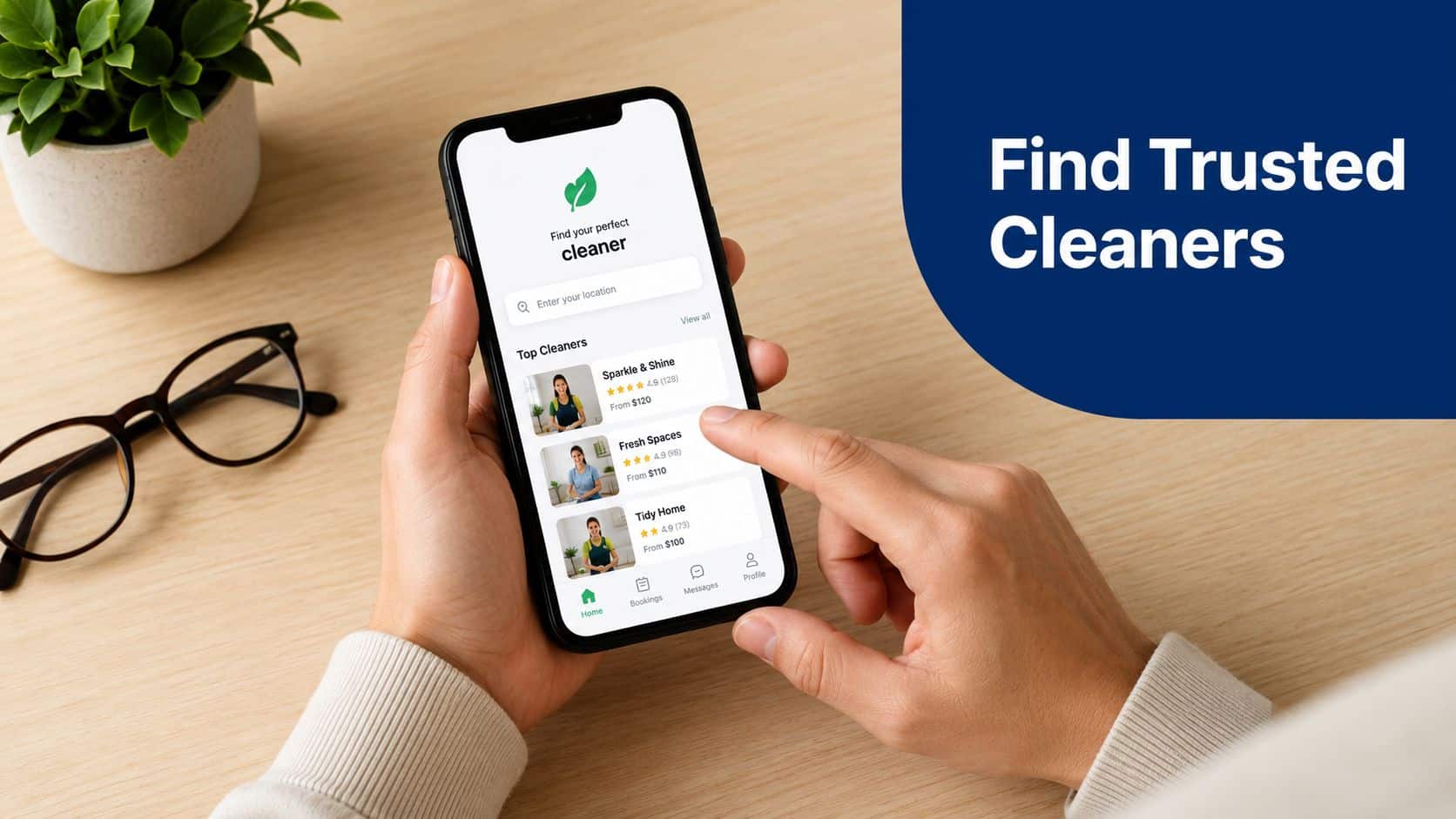
When you're comparing green cleaning companies, a directory profile should help you verify the basics quickly. You want clear service descriptions, signs that the cleaner is insured, and enough detail to ask sensible follow-up questions.
That's why vetting signals matter. If you want to understand what those checks look like before you start browsing, read how Cleaner Connect vets cleaners and builds trust from the start.
Use reviews properly
Reviews help, but only if you read them well. Don't stop at the rating. Look for comments that mention punctuality, communication, care with surfaces, and whether the cleaner did what they said they would do.
If you want an example of how customer feedback can reveal service quality in practice, these customer experiences with Remotecleaners show the sort of details worth paying attention to when judging any cleaning provider.
Here's my advice. Shortlist a few green cleaning companies, compare what they disclose, then message them with the checklist from this article. The company that answers clearly and confidently is usually the safer bet.
If you're ready to compare local green cleaning companies with more confidence, start with Cleaner Connect UK Ltd. You can search by cleaning category and location, browse cleaner profiles, check reviews, and message professionals directly. It's the simplest way to find trusted, insured and ID-checked local cleaners while using a smarter checklist than “eco-friendly” alone.