Thinking about how to start a cleaning business? It’s a brilliant move. To build a business that lasts, however, you need more than just a mop and a can-do attitude. You need a proper professional foundation.
Getting your legal structure, insurance, and finances in order from day one is what separates a hobby from a real business. It’s what gives clients the confidence to hire you and sets you up for success.
Building Your Professional Foundation
Before you even think about buying your first bottle of cleaner, there are a few key decisions to make. These choices will affect how you pay tax, what your personal risks are, and how much paperwork you’ll have to deal with.
Let’s get it right from the start.
Choosing Your Business Structure
For anyone starting out in the UK cleaning industry, the choice usually boils down to two options: setting up as a sole trader or a limited company. Each has its own pros and cons, and the right choice really depends on your goals.
Deciding which route to take can feel daunting, so here’s a quick comparison to make it clearer.
Business Structure Comparison: Sole Trader vs Limited Company
| Feature | Sole Trader | Limited Company |
|---|---|---|
| Liability | Unlimited personal liability. You are the business, so your personal assets are at risk if the business has debts. | Limited liability. Your personal assets are protected because the company is a separate legal entity. |
| Setup & Admin | Simple and quick to set up. Just register with HMRC for Self Assessment. Less ongoing paperwork. | More complex. You must register with Companies House and file annual accounts and confirmation statements. |
| Tax | You pay Income Tax on all profits through your Self Assessment tax return. | You pay Corporation Tax on profits. You then pay yourself a salary (subject to PAYE) and/or dividends. |
| Perception | Seen as a small, personal operation. Perfect for getting started. | Often perceived as more professional and established, which can help win larger contracts. |
Ultimately, there's no single "best" answer.
A sole trader setup is the simplest way to get going. You are the business. There's minimal red tape, and you keep all the profits after tax. The major downside is that if the business gets into debt, you're personally responsible.
A limited company is a separate legal 'person'. This is the biggest advantage—it protects your personal assets. If the business fails, your house and savings are safe. It can also be more tax-efficient as you grow and presents a more professional image, but it definitely comes with more admin and accounting responsibilities.
Think about where you want to be in a few years. If your plan is to stay small, working on your own, then being a sole trader is probably the perfect fit. But if you have ambitions to hire a team and build a larger brand, starting as a limited company might be the smarter long-term move.
Securing Essential Insurance
Whichever structure you pick, business insurance is completely non-negotiable. The one policy you absolutely must have is Public Liability Insurance.
This is your financial safety net. Imagine the nightmare scenarios: you accidentally spill bleach on a client’s brand-new wool carpet, or you knock over and smash an expensive vase. Without insurance, the cost of putting that right comes directly from your own pocket.
For a small annual premium, you get peace of mind and show clients you’re a serious professional. You can find out more about what insurance you need as a new cleaner in our dedicated guide.
Managing Your Finances Professionally
From the very beginning, keep your business finances separate from your personal money. The easiest way to do this is to open a dedicated business bank account.
Doing this makes tracking your income and outgoings so much easier, which is a lifesaver when it's time to do your Self Assessment tax return for HMRC. Trying to untangle business expenses from your weekly food shop is a headache you just don't need. A separate account keeps things clean and looks far more professional to clients and suppliers.
The UK cleaning sector is a fantastic place to be right now. Research shows that a huge proportion of the industry's businesses are micro-enterprises with fewer than 10 employees. This just goes to show there’s a huge market for dedicated, local cleaners who offer a trusted service.
For some more general advice that applies to all trades, you can also learn how to start a service business with this excellent guide.
Setting Your Prices and Managing Finances

Figuring out what to charge is often the biggest mental hurdle when you’re starting out. Go too high, and you might scare off those crucial first clients. Go too low, and you'll quickly find yourself working flat out for very little reward, which is the fastest way to burn out.
The secret isn’t guesswork. It’s about building a pricing structure that feels fair in your local area but is profitable enough to actually let your business grow. Let's break down how to get it right.
Choosing Your Pricing Model
You’ll generally charge for your cleaning services in one of two ways: by the hour, or a flat rate for the entire job. The right choice usually comes down to the type of clean you’re doing.
- Hourly Rate: This is perfect for regular domestic cleans where the job is pretty consistent each week. It’s completely transparent for the customer and guarantees you’re paid for every minute you’re there.
- Flat Rate: This works far better for bigger, one-off jobs like deep cleans or end-of-tenancy cleans. You assess the property beforehand and give a single, fixed price, which gives the client total certainty on the final cost.
A regular two-hour weekly clean for a two-bed flat is a classic hourly rate job. But if you were doing an end-of-tenancy clean on that same flat, a flat rate is the smarter move. It protects you if the job ends up taking six hours instead of the four you estimated.
Calculating Your Profitable Rate
To set a price that genuinely makes you money, you have to know your costs inside and out. Don't just pull a number from thin air. Your pricing must cover all your outgoings and still leave a healthy margin for your own wages and future growth.
Your calculation needs to include:
- Cleaning Supplies: The cost of every product, cloth, and bin bag you use.
- Equipment Depreciation: Your vacuum cleaner has a limited lifespan. A small amount from each job should go towards its eventual replacement.
- Travel Costs: Factor in your fuel or public transport fares for getting to and from jobs.
- Insurance & Admin: Your public liability premium, bank fees, and any marketing costs (like a Cleaner Connect profile).
- Your Salary: Decide what you realistically want to earn per hour for your time.
- Profit Margin: This is the extra bit on top, usually 15-20%, that you can reinvest to grow the business.
A common mistake is only thinking about the time spent cleaning. You must also account for travel time, admin time, and the cost of all your supplies. For a more detailed breakdown, check out our guide on how to price your cleaning services properly.
Demystifying Your Financial Admin
Getting a grip on your finances from day one is essential for long-term success and keeping HMRC happy. As a sole trader, this means you'll need to complete a Self Assessment tax return each year.
The UK's cleaning sector is a powerhouse, contributing tens of billions to the economy. Cleaning activities alone make up a massive chunk of that, proving the huge demand is there. With the vast majority of cleaning businesses being micro-enterprises, it shows you can build a solid operation without a huge initial investment, especially when you use platforms like Cleaner Connect to find clients. You can read more in this British Cleaning Council report summary.
To manage your finances properly, you absolutely must keep clear records of:
- All Income: Every single payment you receive from clients.
- All Business Expenses: Keep receipts for supplies, fuel, insurance, your phone bill—anything you buy for the business.
To look professional and maintain healthy cash flow, using an efficient online invoice system is a game-changer. It helps you create, send, and track payments without the fuss, ensuring you get paid on time and have a crystal-clear record of your earnings for tax season.
Equipping Your Business for Safety and Success
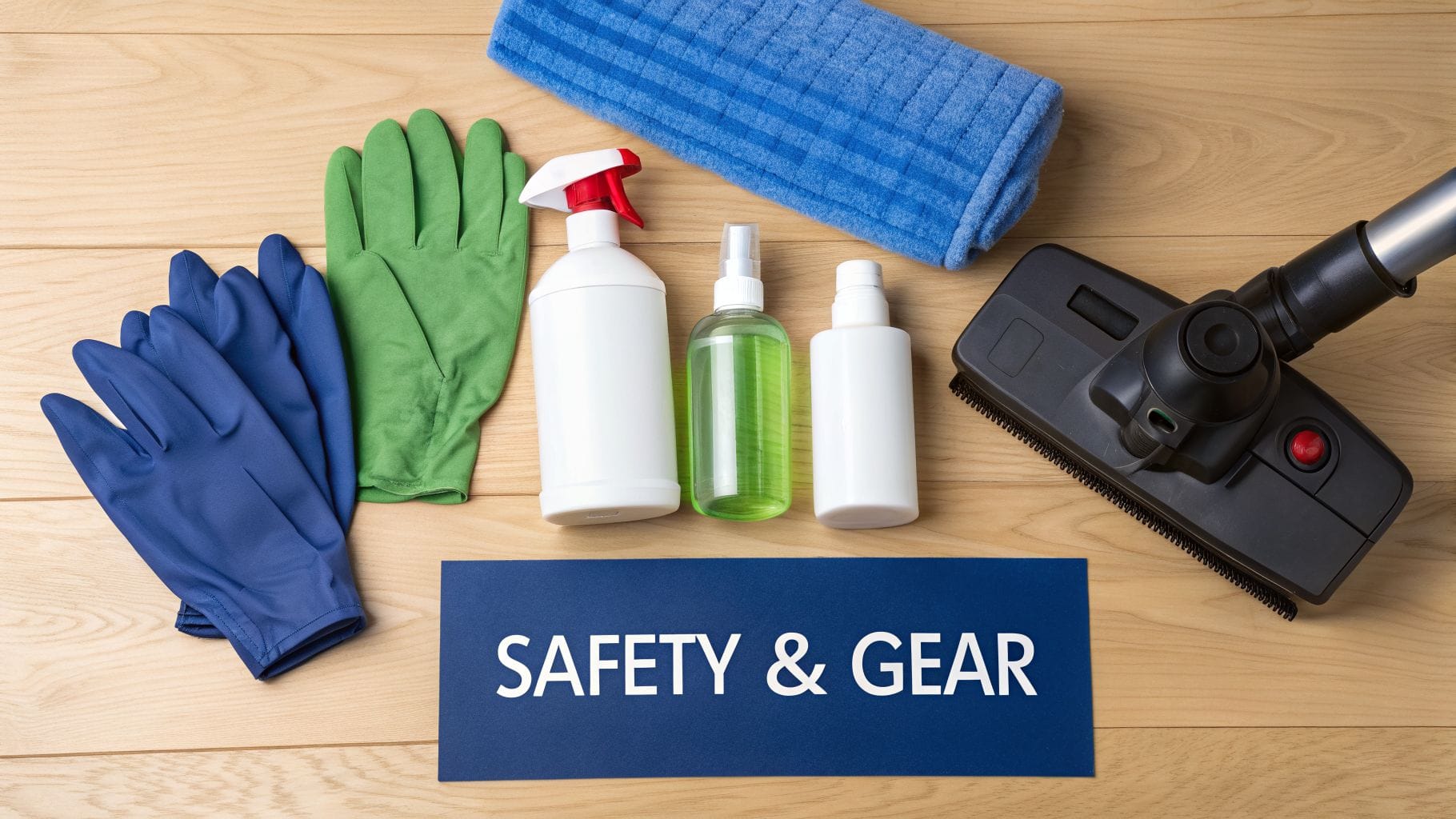
The right tools and a serious approach to safety are what separate the professionals from the amateurs. Showing up with a carrier bag full of supermarket own-brand sprays doesn’t build trust. It tells a client you’re not serious.
Investing in proper equipment isn’t just about looking the part. It’s about working more efficiently, getting better results, and operating safely in someone else’s home. Let’s break down the kit you actually need and the safety duties you can’t afford to ignore.
Your Essential Starter Kit
When you start a cleaning business, you don’t need every gadget under the sun. You need a solid, reliable set of professional-grade tools that won’t let you down. Quality here is non-negotiable, as this kit will be your daily workhorse.
Here’s a practical checklist of what to get first:
- A High-Performance Vacuum Cleaner: Find a lightweight but powerful model with attachments for different surfaces. Think carpets, hard floors, and upholstery.
- Microfibre Cloths: Get a big, colour-coded stack. This is crucial for preventing cross-contamination. A simple system like blue for glass, green for general surfaces, and red for bathrooms works perfectly.
- Professional Cleaning Solutions: Start with concentrated, effective products. A good multi-surface cleaner, glass cleaner, bathroom descaler, and a solid degreaser will cover most jobs.
- A Mop and Bucket System: A quality flat mop or a spin mop system is worlds better than an old-school string mop. It’s more hygienic and delivers a far better finish.
- A Caddy or Carry-All: This keeps everything organised and makes you look professional moving from room to room.
It’s also smart to add eco-friendly product options to your kit. More and more clients are looking for cleaners who use non-toxic, sustainable solutions. Offering this choice is an easy way to stand out.
Understanding Health and Safety Duties
Working with cleaning chemicals means you have a legal and moral duty to handle them safely. This is where the Control of Substances Hazardous to Health (COSHH) regulations come into play.
COSHH is the law requiring employers to control hazardous substances. Even if you’re a sole trader, you are responsible for your own safety and that of your clients. It means you must understand the risks of the products you use and take sensible precautions.
Your responsibility under COSHH is straightforward: read the product labels, understand the hazard symbols, use the correct Personal Protective Equipment (PPE) like gloves or goggles, and store your chemicals safely. It's about protecting yourself and giving your clients complete peace of mind.
The Power of a DBS Check
When you start a cleaning business, you are asking people to trust you in their home—their most private space. Anything you can do to build that trust instantly gives you an edge. A DBS (Disclosure and Barring Service) check is one of the quickest ways to do it.
A Basic DBS check confirms you have no 'unspent' criminal convictions. It’s official proof of a clean record, which is a massive reassurance for any homeowner thinking of hiring you.
This isn't just a box-ticking exercise; it's a powerful marketing tool. On a platform like Cleaner Connect, a verified DBS check is a major trust signal. When potential clients are comparing profiles, seeing that official verification often seals the deal. It immediately separates you from casual cleaners and shows you’re a trustworthy professional they can confidently let into their home.
Finding Your First Clients and Marketing Your Services
You’ve handled the legal bits, worked out your pricing, and got your equipment ready. Now for the part that actually pays the bills: finding your first clients.
When you first start a cleaning business, your marketing budget is probably next to nothing. That’s fine. Getting those first few bookings isn’t about spending big; it’s about being smart and building trust where it matters most.

Your first jobs are more than just money. They’re your chance to prove yourself, gather reviews, and refine your entire process.
Getting Your First Bookings
In the beginning, your best marketing tools are your own two feet and a bit of confidence. Don't underestimate old-fashioned word-of-mouth, especially in an industry built on trust.
Start with your immediate network.
- Tell Friends and Family: Let everyone you know that you’ve launched. They might not need a cleaner, but they almost certainly know someone who does.
- Use Local Community Groups: Post a friendly intro on local Facebook groups or the Nextdoor app. Introduce yourself and what you offer—don’t just spam a link.
- Simple Flyers and Business Cards: A clean, professional-looking flyer still works. Pin them to community notice boards in supermarkets, post offices, and local shops.
These early wins create a local buzz. One happy client tells a neighbour, who tells a colleague, and your diary slowly starts to fill. But to really speed things up and look like a serious professional, you need a proper online presence.
The Power of an Online Directory
Local networking gets your foot in the door, but a professional online profile works for you 24/7. This is exactly what a specialised directory like Cleaner Connect is for. It’s built to put credible, verified cleaners like you in front of people who are actively searching for your services right now.
Think of it as the modern Yellow Pages, but built entirely on proof and trust. You’re not just another name on a list; you’re building a rich profile that shows a customer exactly why they should pick you. For more on this, check out our guide on how to get cleaning clients in the UK.
Build Instant Credibility with Cleaner Connect
A basic subscription is a tiny monthly investment that unlocks a powerful set of tools. It turns a simple listing into a compelling sales pitch that works for you around the clock.
Here’s how a verified profile helps you win work:
- Showcase Verifications: Your profile gets badges for ID Checks and Verified Insurance. These are immediate trust signals that tell clients you’re a legitimate, responsible professional.
- Collect and Display Reviews: After a job, you can invite clients to leave a review. A growing list of positive feedback is the single most powerful way to turn a searcher into a booking.
- Detail Your Services: Clearly list everything you do, from regular domestic cleans to one-off jobs like oven or carpet cleaning. This helps you attract the right kind of client.
Your Cleaner Connect profile acts as your digital shopfront. A potential client can see you're insured, ID-checked, and have great reviews, all in one place. This removes doubt and makes their decision to contact you incredibly simple.
With features like premium listings to boost your visibility and multi-area coverage, you can target the specific postcodes you want to work in. It puts your business directly in front of people who are looking for a cleaner in their area, making it one of the most cost-effective ways to grow when you first start a cleaning business.
Scaling Your Business and Growing a Team
As your diary fills up and you start turning down work, you’ll hit one of the most exciting—and daunting—challenges in your business journey: growth. Moving from a busy solo cleaner to a business owner with a team is a huge leap. This is where your operation starts to feel like a real, scalable company.
It demands a completely different mindset. You’re no longer just the person with the microfibre cloths; you're becoming a manager. You’re now responsible for hiring, quality control, and handling client relationships on a much bigger scale. Getting this transition right is everything if you want to grow without damaging the reputation you’ve worked so hard to build.
Deciding on Your First Hire
When you need that first extra pair of hands, you have a big decision to make: do you hire an employee or bring on a subcontractor? The two paths have very different impacts on your costs, control, and legal duties.
Employees: Hiring a direct employee gives you maximum control. You set their schedule, dictate the cleaning methods, and provide them with your branded uniform and equipment. But this control comes with responsibilities. You’ll need to pay at least the National Minimum Wage, handle PAYE tax and National Insurance, provide paid holidays, and enrol them in a workplace pension scheme.
Subcontractors: A subcontractor is a self-employed individual you contract for a specific job. They typically use their own equipment, hold their own insurance, and sort out their own tax. This route offers more flexibility and far less admin for you, but it also means you have less direct control over how and when they work.
For most new businesses dipping their toes into expansion, using subcontractors is a popular first move. It’s a lower-risk way to see if you can manage a bigger workload without taking on the full financial and legal weight of being an employer straight away.
Finding and Vetting Reliable Team Members
The people you bring into your business are a direct reflection of your brand. One bad hire can undo months of positive reviews and hard work. Because of this, your recruitment process has to be thorough.
Look for people who are obviously reliable, have a genuine work ethic, and show a sharp eye for detail. When you interview them, throw in some scenario-based questions to see how they think on their feet. For example, "What would you do if you arrived at a client's house and realised you’d forgotten a crucial cleaning product for the job?" Their answer tells you a lot about their problem-solving skills.
Always, always check references. A five-minute call to a previous employer or a regular client can reveal more about someone's reliability and standards than their CV ever will. Trust is the absolute foundation of this industry.
Training and Maintaining Quality Standards
Whether you hire an employee or use a subcontractor, proper training is non-negotiable. Never assume someone knows how to clean to your standard. It's your job to train them on your specific methods, the products you stand by, and your expectations for brilliant customer service.
Put together a simple training checklist. It should cover:
- Your step-by-step cleaning process for every room.
- How to use and dilute your chosen chemical products correctly.
- Key health and safety rules, especially COSHH.
- How to communicate professionally and courteously with clients.
Consistent quality is what turns a one-off clean into a regular, long-term contract. By standardising your training, you make sure every client gets the same fantastic service, no matter which member of your team shows up.
Professional Service Agreements
As you grow, handshake agreements just won’t cut it anymore. A professional service agreement (or contract) for every client becomes essential. This document should clearly lay out the scope of work, the cleaning schedule, your payment terms, and your cancellation policy.
This isn’t about being overly corporate or intimidating. It’s about managing expectations and protecting both your business and your client. A clear agreement stops misunderstandings about what is (and isn't) included in a clean, making sure everyone is on the same page from day one. It’s a mark of professionalism, and good clients will appreciate it.
Common Questions About Starting Your Cleaning Business
Even with a solid plan, a few questions always pop up right before you start. Let’s tackle the most common ones we hear from new cleaning business owners, so you can move forward with confidence. Think of this as a final check to clear up any last-minute doubts.
What Is the Realistic Cost to Start a Cleaning Business in the UK?
You can get going for a lot less than you might imagine. Realistically, you can launch a professional cleaning business for under £500.
This isn't about cutting corners; it’s about focusing on the absolute essentials you need to operate safely and look the part from day one.
- Public Liability Insurance: This is your safety net. Expect to pay around £50-£100 for a year's cover.
- Professional Starter Kit: Budget between £200-£400. This gets you a quality vacuum, a proper set of colour-coded microfibre cloths, a good mop system, and professional-grade cleaning solutions.
- Basic DBS Check: At about £18, this is one of the most powerful trust signals you can have.
- Initial Marketing: A subscription to a directory like Cleaner Connect puts you straight in front of local customers for a small monthly outlay.
The key is to invest in what you need to deliver a fantastic service from your very first job. You can then reinvest your early earnings to build out your toolkit and grow sustainably.
Is Insurance Really Necessary for Cleaning Houses?
Yes. It's completely non-negotiable. Think of public liability insurance as your professional safety net. It’s what stands between you and financial disaster if you accidentally break a client’s antique vase, damage a carpet with the wrong chemical, or someone trips over your vacuum lead.
For a relatively small annual fee, you get total peace of mind. More importantly, it shows clients you're a serious, responsible professional who respects their property.
On a platform like Cleaner Connect, having a 'Verified Insurance' badge is one of the fastest ways to build trust. When a potential client sees that badge on your profile, it instantly tells them you’re a safe pair of hands.
How Do I Get Clients When I Have No Reviews?
Don't worry, every single successful cleaning business started with zero reviews. Letting that hold you back is a mistake. The trick is to be strategic and build trust in other ways.
A great approach is to offer a small 'introductory discount' to your first few clients. In exchange for the slightly lower rate, politely ask for an honest, detailed review for your Cleaner Connect profile once the job is done.
Beyond that, a complete, professional profile is your best friend. A profile that clearly lists your services, shows off your verified insurance and ID check, and has well-written descriptions builds huge trust, even before you have a dozen reviews. People hire professionals, and a complete profile makes you look like one from the get-go.
What Is the Most Important Factor for Business Growth?
Without a doubt, it’s building trust. You’re being invited into people's private homes and offices—their most personal spaces. Reliability and integrity are everything. This isn't just about doing a good job; it's about becoming the person they know they can count on.
Trust is built piece by piece, through:
- Consistent Quality: Delivering the same high standard of cleaning, every single time.
- Clear Communication: Being easy to reach, replying promptly, and making sure everyone knows what to expect.
- Total Transparency: Being upfront and honest about your pricing, services, and policies.
Using a trusted directory like Cleaner Connect helps you fast-track this whole process. When a potential client sees your profile is backed by ID checks, verified insurance, and positive feedback from other locals, their decision to hire you becomes simple. In the long run, your reputation will become your most powerful marketing tool, driving referrals and fuelling your growth for years.
Ready to find your first clients and grow a reputable cleaning business? Join the community of trusted professionals on Cleaner Connect. Sign up today and build a verified profile that helps customers find and hire you with confidence. Get started at https://cleanerconnect.co.uk.
Prepared with the Outrank app